

A Director’s Loan Account (DLA) records money a director takes from or lends to their company outside of salary, dividends, or expense reimbursements.
A Director’s Loan Account becomes overdrawn when the director takes more money from the company than they are entitled to. In effect, the director has taken a loan from the company.
This guide explains:
What an overdrawn Director’s Loan Account is
How it happens
How to repay it
The tax implications and Section 455 tax rules
How to prevent it happening again
What Is an Overdrawn Director’s Loan Account?
A Director’s Loan Account becomes overdrawn when a director withdraws more money from the company than:
Salary received
Dividends declared
Money previously loaned to the company
When this happens, the director effectively owes money back to the company.
This is treated as a loan from the company to the director.
How a Director’s Loan Account Becomes Overdrawn
Directors typically take money from a company in three ways:
1. Repayment of money they previously lent the company
If a director puts their own money into the business, the company can repay it tax-free.
2. Salary through payroll
Directors usually take a tax-efficient salary through PAYE.
3. Dividends from company profits
Dividends can only be paid from after-tax profits.
If a director withdraws more money than these three sources allow, the Director’s Loan Account becomes overdrawn.
Example of an Overdrawn Director’s Loan Account
Tom owns a limited company.
During the year:
Tom lent the company £2,000
Tom received £9,600 salary
His accountant confirms £25,000 available dividends
Total Tom can withdraw:
£2,000 loan repayment
£9,600 salary
£25,000 dividends
Total: £36,600
However, Tom has already withdrawn £48,000 from the business.
This means Tom has taken £11,400 more than he is entitled to.
Tom’s Director’s Loan Account is therefore overdrawn by £11,400.
Tom now owes the company £11,400.
How to Clear an Overdrawn Director’s Loan Account
There are several ways to repay an overdrawn Director’s Loan Account.
1. Repay the Money Personally
The simplest solution is to transfer the money back to the company from your personal bank account.
This clears the loan immediately.
2. Declare Dividends
If the company has sufficient profits, dividends can be declared and used to offset the loan balance.
Example:
Loan owed: £11,400
Dividend declared: £11,400
The loan account becomes zero.
3. Increase Salary or Pay a Bonus
A director can take additional salary or a bonus through payroll and use this to repay the loan.
However, this will trigger:
PAYE income tax
National Insurance
So professional advice is recommended.
4. Leave It Until Future Profits
The company can declare dividends in the following year and apply them to the outstanding loan.
However, this must be done carefully because tax deadlines apply.
5. Write Off the Loan
In some cases the company may write off the loan.
If this happens:
It may be treated as dividend income
Income tax may be payable by the director
Section 455 Tax on Overdrawn Director’s Loan Accounts
If the Director’s Loan Account remains overdrawn 9 months and 1 day after the accounting period ends, the company must pay Section 455 tax.
The tax rate is currently 33.75% of the outstanding loan.
Example:
Loan balance: £11,400
Section 455 tax:
£11,400 × 33.75% = £3,847.50
This tax is paid through the company’s corporation tax return.
Can Section 455 Tax Be Reclaimed?
Yes.
If the director repays the loan later, the company can reclaim the Section 455 tax from HMRC.
However, the reclaim usually happens after the end of the accounting period when the loan is repaid, meaning the company may wait some time to recover the tax.
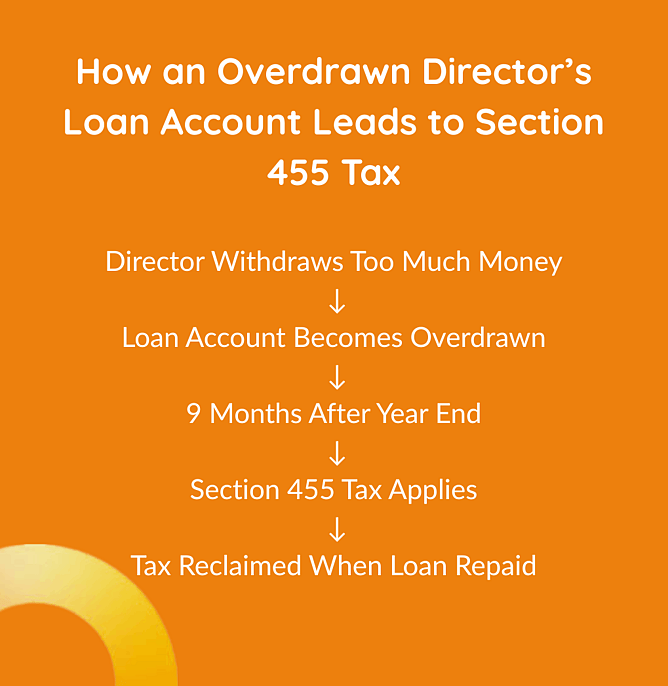
Flowchart showing how an overdrawn Director’s Loan Account can trigger Section 455 tax if not repaid within 9 months after the year end.
Benefit in Kind Tax on Director’s Loans
If a Director’s Loan exceeds £10,000 at any point in the year, HMRC may treat it as a benefit in kind if no interest is charged.
This means:
The director pays income tax on the benefit
The company pays Class 1A National Insurance
The benefit is calculated using HMRC’s official interest rate.
Example:
Loan balance: £11,400
HMRC official rate: 2.25%
Interest benefit:
£11,400 × 2.25% = £256.50
This amount is declared on the director’s P11D form.
How to Reclaim Corporation Tax Paid on Director’s Loans
If Section 455 tax has been paid, the company can reclaim it once the loan is repaid.
This can be done:
Within the next corporation tax return, or
By submitting Form L2P to HMRC
The reclaim must usually be made within 4 years of the loan repayment.
How to Prevent an Overdrawn Director’s Loan Account
The best way to avoid problems with Director’s Loan Accounts is good financial management.
Key steps include:
Keep bookkeeping up to date
Regular bookkeeping allows you to see how much you can safely withdraw.
Use management accounts
Monthly or quarterly management accounts show:
Company profits
Available dividends
Loan balances
Plan withdrawals with your accountant
Your accountant can help structure income through:
Salary
Dividends
Pension contributions
This ensures withdrawals remain tax-efficient and compliant.
Summary
An overdrawn Director’s Loan Account occurs when a director withdraws more money from the company than they are entitled to through salary, dividends, or loan repayments.
The balance can be cleared by:
Repaying the money personally
Declaring dividends
Increasing salary or bonuses
Writing off the loan
If the loan is not repaid within 9 months and 1 day after the company year end, the company must pay Section 455 tax.
Keeping accurate bookkeeping and reviewing finances regularly can help prevent Director’s Loan Accounts from becoming overdrawn.
If we can help in any way, please contact us
Common FAQs
Can a Director’s Loan Account be written off?
Yes. The company can write off the loan, but the amount may be treated as income or dividends for tax purposes.
What is the 9-month rule for Director’s loans?
If a loan to a director is not repaid within 9 months and 1 day of the accounting period end, the company must pay additional corporation tax.
Do directors pay interest on loans from their company?
If the loan exceeds £10,000 and no interest is charged at HMRC’s official rate, the loan may be treated as a benefit in kind.